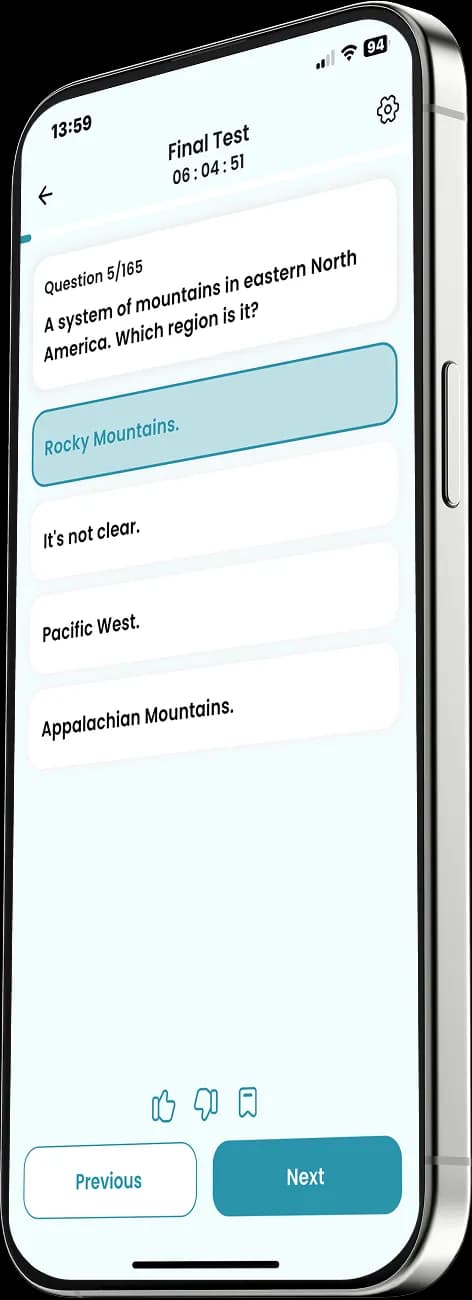
Questions
Questions
to practice anytime, anywhere!



A full-length GED science practice test helps you prepare for the pace, question variety, and reasoning demands of the official exam. By completing a complete test in one session, you can practice reading scientific passages, interpreting data, and evaluating experiments under realistic conditions. It also gives you a clearer view of your strengths, weak areas, and overall readiness before test day.
A full-length practice test covers the main concepts and reasoning skills assessed on the GED Science exam. Questions may include written passages, graphs, tables, diagrams, formulas, and descriptions of experiments. The test focuses less on memorizing isolated facts and more on using scientific information to reach logical conclusions.
Many questions ask you to analyze how an experiment is planned or conducted. You may need to identify a hypothesis, independent variable, dependent variable, control group, or experimental condition.
You could also be asked to determine whether the evidence supports a conclusion or identify a weakness in an investigation. These questions measure how well you understand the scientific method and whether you can evaluate the reliability of results.
Life science questions cover living organisms and biological processes. Common topics include cells, genetics, heredity, evolution, ecosystems, and human body systems.
You may need to interpret a food web, analyze how a trait is inherited, or predict how a change in the environment could affect a population. Questions often provide the information you need in a diagram, data table, or short passage, so careful reading is essential.
Physical science includes basic principles from chemistry and physics. Questions may address forces, motion, energy, electricity, atoms, molecules, chemical reactions, and the properties of matter.
You might be asked to interpret a motion graph, compare forms of energy, or explain what happens during a physical or chemical change. Some questions include calculations, but the main goal is usually to apply scientific principles correctly.
Earth and space science questions may cover weather, climate, natural resources, geological processes, the solar system, and interactions among Earth’s systems.
You may need to analyze climate data, explain erosion, interpret a diagram of the water cycle, or determine how human activity affects the environment. These questions often combine science knowledge with reading and data interpretation skills.
A full-length GED Science practice test includes several questions based on graphs, charts, tables, and experimental results. You may need to compare values, calculate an average, identify a trend, or choose the conclusion best supported by the data.
Always review titles, labels, units, and scales before answering. Small details can change the meaning of the information presented.
For broader preparation across every GED subject, take our GED practice test to review Science, Math, Reasoning Through Language Arts, and Social Studies.
Taking a full-length GED science practice test can help you improve your pacing, strengthen your reasoning skills, and identify the science topics that need more review. Complete each test under realistic conditions, then study every explanation and revisit difficult questions. With regular full-length practice, you can become more comfortable interpreting scientific information and approach the GED Science exam with greater confidence.